
How to Secure a Farm, Ranch, or Job Site With No Power and No Internet
Fuel theft. Trailer break-ins. Copper gone from the pump house. And the nearest outlet — 800 feet away. Here’s the deployment plan rural owners actually use, from zone mapping to the camera that reads a license plate at the end of a quarter-mile drive.
Rural and job-site theft isn’t like house burglary. Nobody kicks in a door at 2 AM and grabs a TV. They pull a trailer at dusk. They siphon fuel over a weekend. They come back three times for the copper because they know nobody’s watching — and the sheriff is 40 minutes out.
The fix isn’t more rules or more lights. It’s eyes on the choke points, powered by the sun, connected by cell signal — because running power and internet to a gate 800 feet from the barn costs more than the cameras.
Step 1 — Map Your Property Into Zones
The biggest mistake we see: people buy six cameras and point them at open ground. Open ground is what deer are for. Theft happens at choke points — places a vehicle or a person must pass. Walk your property with a notepad and mark:
- Entrances — the main gate, the back service road, any cut in the fence line
- High-value storage — fuel tanks, tool containers, tack rooms, equipment sheds
- Staging areas — where trailers, ATVs and machinery sit overnight
- The approach — the long stretch where a vehicle has to slow down or turn in
Three to five well-placed cameras at choke points beat ten scattered across open pasture. Write each spot down with two notes: how far is it from everything else, and does my phone get signal there.
Rule of thumb
If your phone shows 2+ bars at the mount point, a 4G camera will hold a connection there. One bar or less — pick a different post, or move the camera and zoom in instead.
Step 2 — Pick Your Connectivity: Single Cameras vs. a Base-Station System
There are two sane architectures for unpowered land:
| Standalone 4G cameras | 4G base-station system (multi-camera) | |
|---|---|---|
| How it works | Each camera has its own SIM and streams independently | Cameras link by long-range wireless to one solar-powered hub; the hub holds the SIM and the storage |
| Best for | 1–3 spread-out points | 4+ points, one barn/yard, growing over time |
| Data plans | One per camera | One for the whole site |
| Watch out for | Multiple apps and bills | Camera-to-hub distance limits |
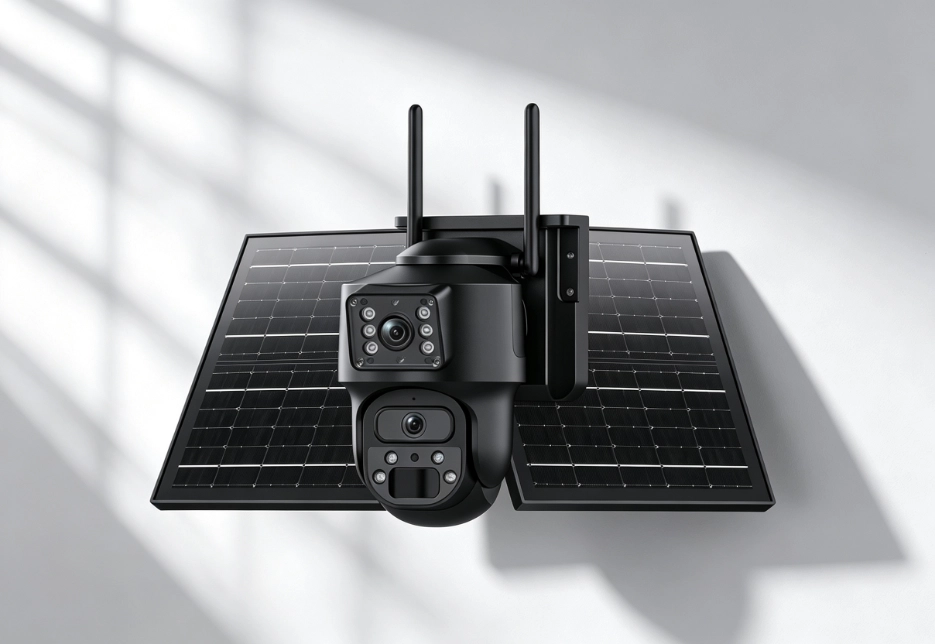
The base-station route is what most working farms end up choosing, because it scales. Our FourSight system pairs wireless cameras with a single 4G hub: cameras reach the hub over their own radio link at 200–300 meters in open terrain, the hub supports up to 16 cameras (the kit starts at four), and the whole site runs off one data plan. The hub itself carries a 20,000mAh battery and a 15W solar panel, and each camera has its own 7,800mAh battery with a 3W trickle panel.
Step 3 — Match the Camera to the Zone
Long driveways and gates: zoom matters
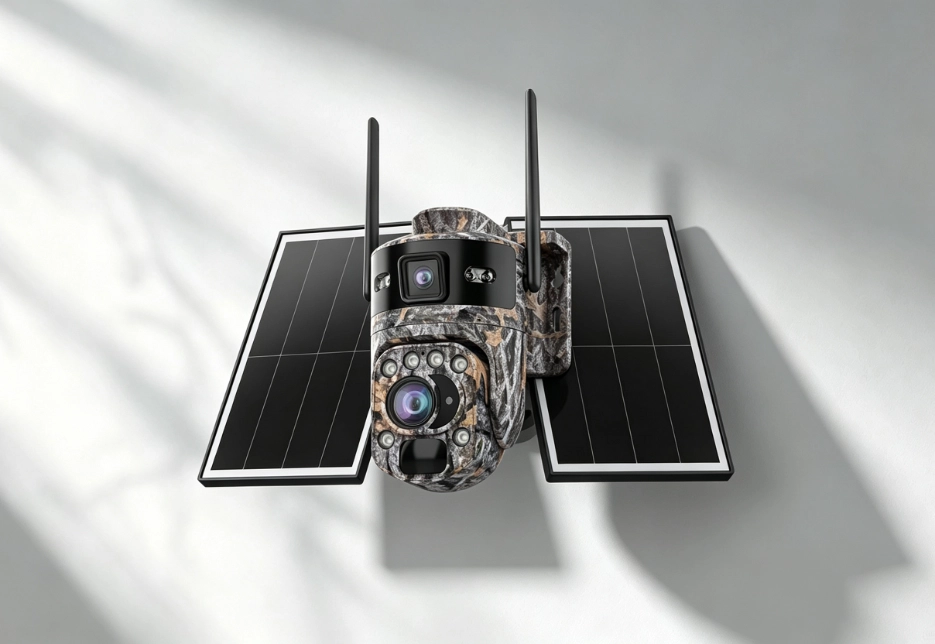
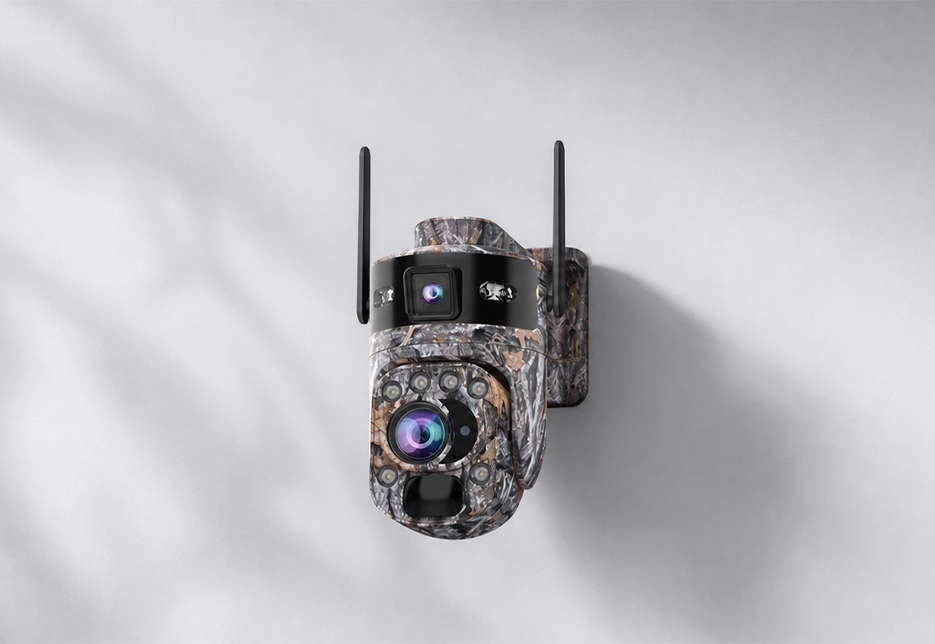
For an approach that’s hundreds of feet long, wide-angle is useless — a truck at 200 feet is eleven pixels wide. You need optical zoom, which magnifies with glass instead of cropping pixels. The Ranger PRO (637) carries a 20x optical + 16x digital zoom (36x combined) on a 4K-class dual-lens body, with night vision out to roughly 100 meters. Park it facing the approach and you can read the gate — or the plate on the truck sitting at it — without leaving the house. It ships in camouflage for a reason: on a fence post, it disappears.
Yards and barn clusters: the base station
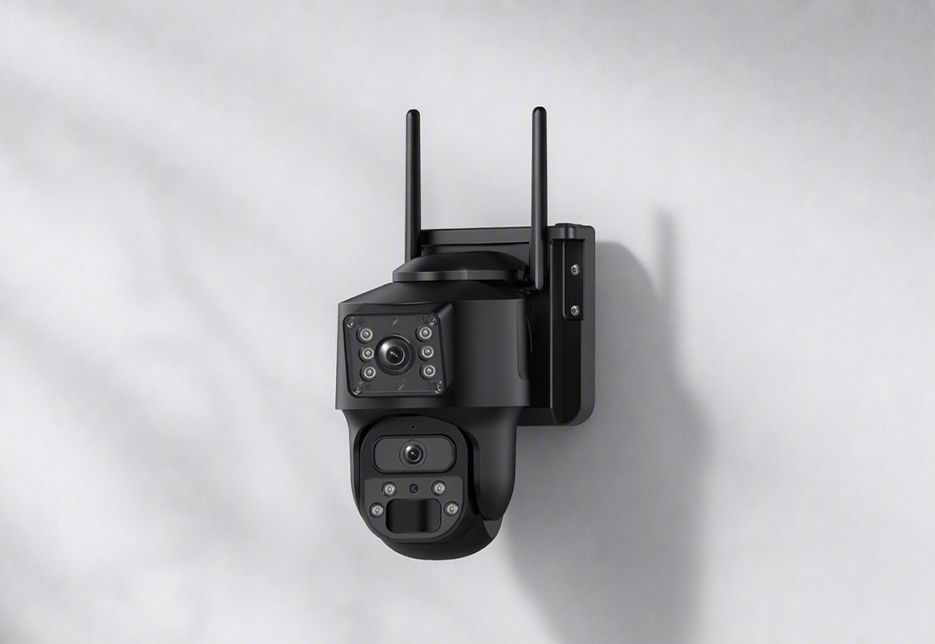
For a cluster of buildings inside 200–300m, FourSight cameras cover the loop — PIR detection at 20–30 meters, white-light color night vision, IP66 housings, one app (Essecloud) for the whole site, footage stored centrally on the hub.
Theft in progress: deterrence beats recording
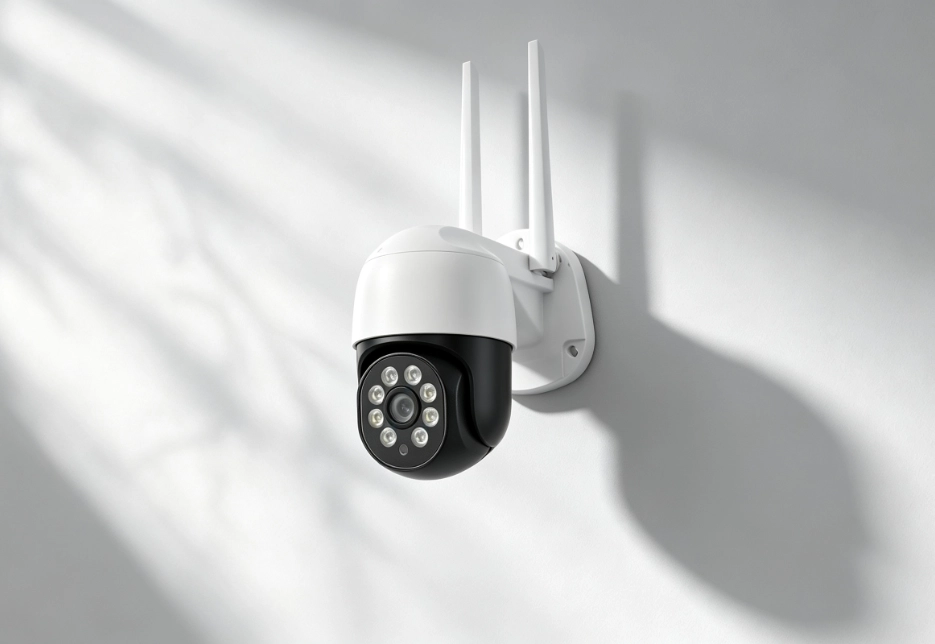
Recording a theft is evidence. Stopping one is better. Two-way talk lets you yell through the camera the moment someone where they shouldn’t be — most opportunistic thieves leave the second a voice comes out of a fence post. If you have mains power somewhere critical, our Oracle Ultra PTZ adds 360° patrol and AI human tracking to that job.
THE WORKHORSE PICK
RV Ranger PRO Wireless (637)
4K-class dual-lens solar camera · 4G · camouflage housing · IP66
- 36x combined zoom (20x optical + 16x digital) for gates and long approaches
- Night vision to ~328ft (100m); dual 14W solar panels + 20,800mAh battery
- AOV always-on recording — no gaps in the timeline
- Two-way talk to run people off before they finish what they started
Installation Tips From the Field
We’ve talked to enough ranchers and site managers to know what actually fails. Steal this checklist:
- Mount 8–10 feet up — above grabbing hands, below the point where faces become hats
- Angle down 15–30° toward the approach, not the horizon
- Test signal before drilling — phone check at every mount point, 2 bars minimum
- Solar panels: open sun, tilted to your latitude, cleaned monthly — a panel under a tree is decorative
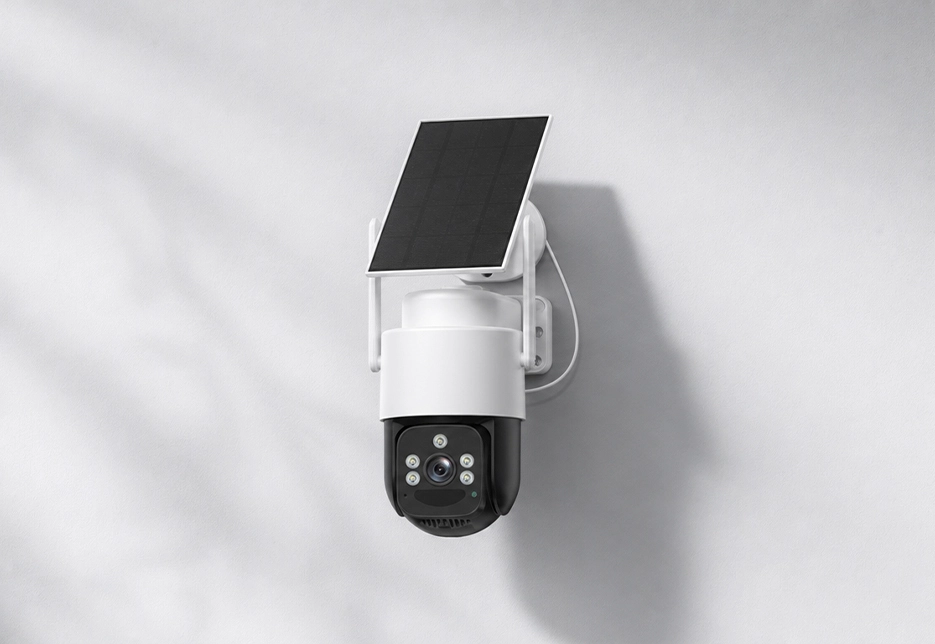
- Use the extension cable to separate panel and camera — best sun isn’t always best view (537 ships with a 3m cable, 637 with 2m)
- Set PIR sensitivity for animals — enable human filtering, or a herd of elk will own your notification tray and your battery
- Insert a large microSD — up to 512GB on supported models; local storage means no subscription to see your own footage